Yager Interview
This is a private page for Yager’s eyes only.


Meeting Frê
After my first interview with Frê, the idea of transitioning to the gaming industry became more tangible than ever before.
Although my portfolio is very diverse in UI design, it has very limited examples specific to gaming. I wanted to ensure that I could convey my strong interest in shifting to the gaming industry (as my passion for UI originated in gaming) and explain why, after many years of designing UI and my particular set of skills, I believe I am better suited for the game industry than any other sector.


Starting from ArtStation
I wanted to design a couple of screens featuring common UI use cases. For my compositions, instead of using Midjourney directly, I chose to select a couple of artists on ArtStation (with proper references and credit) and picked a set of images to use as my backdrop.
Using a specific, finite, set of images would establish clear boundaries for this “project”, both visually and conceptually, as I aimed to complete it within a few days before my second interview with Olli and Jasmina.


Then I used some assets from the equaly talented Lokki to compose some of my designs;
(https://www.artstation.com/l0kki/albums/8453143)
Found the ridiculously amazing work of Abrar Khan and his Astral series;
(https://www.artstation.com/abrar_khan/albums/11212092)

The Astral Series
I tend to gravitate to sci-fi themes; the Astral series images served as the catalyst for all the ideas and concepts for my designs.
What I’m about to present is not a comprehensive game concept, but rather a collection of abstract ideas and concepts used as placeholders for my UI designs.
By looking at these images, I began to imagine what this game could entail and how these ideas would influence the design and UI use-cases. I also considered the types of assets that could be available to the player and how would they interplay with the main character.
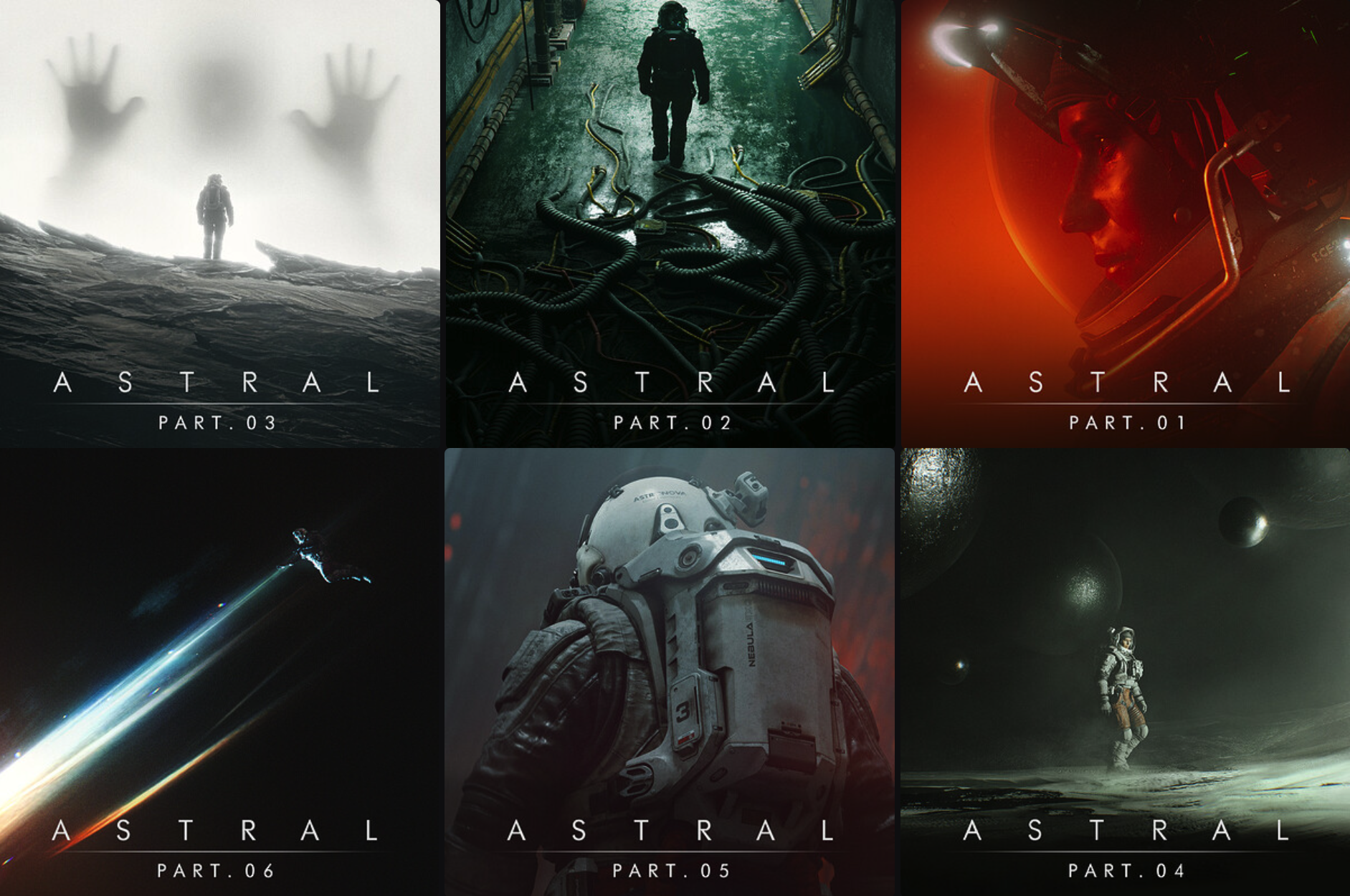

Let’s begin.

Main concept
The Astral series depicts space exploration with an emphasis on loneliness, mystery, and uncharted territory in a near-future setting, as the space suit appears contemporary - I feel this makes us resonate better with the plot compared to an ultra-futuristic, fantasy-layered concept like "Tron”.
To make it present and real, I chose the title "The Case Against Reality," inspired by Donald Hoffman’s book, which I read a year ago.
The book argues that our perceptions of reality are not accurate representations of the external world. Hoffman suggests that evolution has shaped our senses to prioritize survival over truth, providing an interface that helps us navigate life effectively rather than showing us the world as it truly is - I find this a fascinating idea.
The game concept involves a lonely astronaut exploring other worlds in search of the ultimate reality, or more philosophically, the search for truth.

Inventory: connecting UI to narrative
These ideas led me to design an inventory UI focused solely on exploration, deliberately avoiding weapons (which often look impressive in any UI) to adhere to the theme boundaries.
I designed the Aletheia logo at the center of the items wheel; "Aletheia" is the Greek word for "truth."
The info box on the hazard isolation unit reads "Aletheia Corp Property," adding another potential layer to the plot: the branding suggests a private interest in "finding the truth" rather than an altruistic venture for the greater good.
It reminded me of Alien: Prometheus, where the exploration ultimately reveals a private agenda with little altruistic intent, potentially uncovering a deeper "truth" about human nature - again, multiple ways to play with the idea of “finding the truth” that it’s transversal to entire plot.
As I mentioned, these are just loose ideas.
Above, the same Inventory UI, now shown in-game for quick item switching and contextual in-play info.
A dark layer covers everything on the background to prioritize the inventory menu and lock any controller interaction outside the Inventory menu.

Maps & Locations
For an exploration venture, maps are a critical element. I designed a map with multiple levels of zoom to display primary objectives and side/orbital objectives. Each zoom level reveals increasingly detailed information, allowing players to tailor the map to their play style without unnecessary noise.
I referred to the regions as "sectors" to maintain an abstract feel to them, as these are areas were never been explored before
(or so the player is led to think - leaving room for a potential plot twist). Consequently, sectors are not branded with specific names.
Main Sector information is minimal, showing only the percentage of exploration if the player has already visited, and indicating whether the area is on or off-grid, which would limit the use of certain items and actions, and contribute to specific events.
I found this image fantastic, so I thought it would be cool to use it as a quick cutscene when entering a new sector.
This cutscene would zoom out the camera to showcase the enormity of the surroundings, making the player feel small and insignificant - a tiny dot in an infinite universe (emphasizing the weight of reality). I approached this image as if it were part of a game design decision, and my task was to populate it with UI elements to inform the user of what is happening.

Mini-map/Hud
Next, I designed a radar/HUD for the game, which is critical for this type of gameplay. However, I also think it would be interesting to include an ultra-realistic play mode with no HUD in sight.

Failure & Game Over
Lastly, I designed a Game Over screen cause this image was begging for it.
I created a bunch of different phrases to appear randomly, just to reinforce the main concept and ultimate goal of the game.

Animation Mockups

Why this page?
The objective of this abstract use-case is to demonstrate my experience and passion for UI while also expressing my related interests in narratives, storytelling, creative and abstract thinking, research, themes, and lore. These elements are uniquely integrated into gaming and can only be found in gaming.
Shifting my focus to games would essentially be a return to my original plan and interests as a designer, particularly as a creative.
I apologize for any jargon butchering or any possible naive mistake in my designs, but honestly, it feels invigorating to be in this position, the prospect of learning new things, and being the dumbest person in the room - the ultimate antidote to boredom.
Thank you for your time guys!